The Truth About the Tp Link Omada Sg3428Xmpp Network Switch: Pros, Cons, and Verdict
This article examines the Tp Link Omada Sg3428Xmpp network switch in depth, weighing its strengths and weaknesses for real-world buyers. The goal is to present an evidence-based, practical review that helps small business owners, IT generalists, and advanced home lab enthusiasts decide whether this switch fits their needs. It covers hardware and software features, likely use cases, configuration and management, reliability considerations, and a clear buying guide to help readers prioritize what matters.
Introduction
The Tp Link Omada Sg3428Xmpp positions itself as a managed switch for customers who need more control than an unmanaged gigabit switch provides, but who do not want the complexity or the price tag of large enterprise gear. For many organizations—branch offices, retail sites, co-working spaces, and advanced home networks—this type of switch is attractive because it pairs multiport connectivity and management features with the promise of integration into a broader vendor ecosystem.
This review unpacks what buyers typically care about: port layout and throughput, management and firmware, quality-of-service and routing capabilities, physical fit (rackmount, noise, power), and long-term maintenance. It evaluates the Tp Link Omada Sg3428Xmpp from the perspective of day-to-day operations rather than marketing language, offering a practical verdict at the end.
Product analysis: what the Tp Link Omada Sg3428Xmpp offers
Hardware and port configuration
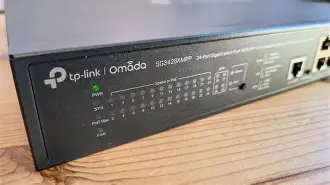
At its core, the Tp Link Omada Sg3428Xmpp is designed to serve networks that need a moderate number of access ports along with higher-speed uplinks. Many variants of similar Omada models follow a pattern: around two dozen gigabit copper access ports complemented by several 10Gb-capable SFP+ or multi-gig uplink ports. This combination makes the switch suitable as a distribution layer device in small-to-medium deployments or as the central switch in a smaller office.
Physical construction typically reflects a rack-mountable chassis, with a front panel of RJ45 ports and SFP/SFP+ slots for fiber or DAC connectivity. Buyers should check whether the unit includes fanless design or active cooling—this affects placement and noise. The model name suggests an emphasis on multi-purpose connectivity and management (the "Omada" name indicates integration with TP-Link’s SDN management platform).
Management and software ecosystem
One of the main selling points for Omada-branded switches is the vendor’s software strategy. The Omada platform provides a unified management plane—controller software that can run on-premises, on an appliance, or in the cloud—so administrators can monitor and configure switches, access points, and gateways from a single console. For organizations that prefer centralized tooling, this integration can significantly simplify provisioning, monitoring, and software updates.
Management features commonly offered include VLAN tagging, port-based access control, link aggregation (LACP), static routing or limited Layer 3 features, QoS policies for voice/video/data prioritization, and ACLs for basic traffic control. The web UI and controller-based workflows aim to be approachable for IT generalists while still offering the controls experienced network engineers expect.
Performance and reliability
Performance expectations for a switch in this class focus on reliable line-rate forwarding on all ports, low latency for local traffic, and predictable throughput over uplinks. Real-world reliability depends on firmware maturity and build quality. For many users, the deciding factors are whether the switch maintains stable operation under load, whether firmware updates are straightforward (and non-disruptive), and whether vendor support is responsive when problems arise.
TP-Link has increased its enterprise feature set in recent years. For deployments that require simple static routes, VLAN segmentation, and QoS, switches like the Sg3428Xmpp are more than capable. For more advanced routing, dynamic routing protocols, or carrier-grade features, organizations should evaluate higher-tier switches or routers.
Looking for the best Electronics deals on Amazon?
Shop Amazon →Use cases where this switch can shine
- Small to medium-sized businesses needing segmentation (VLANs) for departments, point-of-sale systems, and guest Wi‑Fi.
- Branch offices that require centralized management through a single platform for APs, gateways, and switches.
- Advanced home labs or prosumers who want enterprise-style features (SFP+ uplinks, VLANs, QoS) without a steep learning curve.
- Edge distribution in campus closets where 24–28 ports are the right quantity and where a few 10Gb uplinks consolidate traffic to a core switch.
What buyers typically worry about
Potential concerns include long-term firmware support, security patch cadence, the learning curve of vendor-specific management tools, the absence of advanced Layer 3 features for some deployments, and physical characteristics like fan noise and power draw. Buyers often weigh whether the vendor ecosystem locks them in and whether integration with other vendors (for example, existing Wi‑Fi controllers) is straightforward.
Pros & Cons
Pros
- Integrated management: Works with the Omada controller for centralized configuration and monitoring across switches, access points, and gateways.
- Balanced port layout: A mix of gigabit access ports and higher-speed uplink slots covers common small-to-medium deployment patterns.
- Feature-rich for the price segment: VLANs, LACP, QoS, ACLs, and basic Layer 3 functionality address most office needs without enterprise pricing.
- Scalability: Uplink options (SFP/SFP+) allow aggregation into a larger network fabric when needed.
- Clear value proposition: Suits organizations that want managed features and vendor ecosystem integration without high support costs.
Cons
- Not a full-blown enterprise platform: Lacks some advanced routing and carrier-grade features present in top-tier enterprise switches.
- Firmware and update cadence: Depends on vendor support; organizations should verify update policies and test updates before production rollouts.
- Potential vendor lock-in: Best experience often comes from staying inside the Omada ecosystem; mixed-vendor environments may require extra configuration work.
- Physical considerations: If the unit uses active cooling, noise can be an issue in open office spaces; verify fan noise and thermal specs.
- Power and PoE options: This model may not include PoE on all ports—buyers with many powered devices should confirm PoE availability or consider PoE-specific variants.
Comparison
The following table compares the Tp Link Omada Sg3428Xmpp conceptually against two common alternatives: a basic unmanaged gigabit switch and a higher-end enterprise switch. This helps place the product in practical purchasing contexts.
| Feature | Tp Link Omada Sg3428Xmpp | Typical Unmanaged Gigabit Switch | Higher-end Enterprise Switch |
|---|---|---|---|
| Target buyer | Small/medium businesses, branch offices, advanced home labs | Home users, very small offices | Large enterprises, data centers, service providers |
| Management | Managed (web UI + Omada controller) | Unmanaged (plug-and-play) | Fully managed (CLI, advanced controllers, telemetry) |
| Port mix | Many gigabit ports + several 10Gb-capable uplinks | All gigabit ports, no uplinks or SFPs | Multi-gig, 10/25/40/100Gb options |
| Layer features | L2/L2+ with some static L3; VLANs, QoS | L2 only | Advanced L3/L4 routing, EVPN, MPLS |
| Price/Value | Mid-range: balanced | Low | High |
| Ease of deployment | Moderate—controller simplifies multi-device setups | Very easy | Complex—requires experienced network staff |
Buying guide: how to decide if this switch is right
When considering the Tp Link Omada Sg3428Xmpp, buyers should evaluate their current and anticipated needs along several dimensions. Below is a practical checklist and guidance based on common procurement concerns.
1. Port count and uplink capacity
Determine how many devices need wired access today and in 12–36 months. If the deployment involves many cameras, access points, or desktop computers, the typical 24–28 port layout of switches in this class is often appropriate. Confirm uplink capacity: a few SFP/SFP+ 10Gb uplinks can prevent bottlenecks when aggregating traffic to a core switch or NAS.
2. Do you need PoE?
Power over Ethernet is essential if the deployment includes VoIP phones, PoE cameras, or Wi‑Fi access points. Some Omada variants include PoE on selected ports; others do not. If PoE support is required, verify the specific model’s PoE budget and which ports are powered.
3. Management and ecosystem
Consider whether centralized management across multiple device types is valuable. The Omada controller simplifies cross-device configuration and monitoring. If the organization already uses a different vendor’s controller, evaluate interoperability or whether migrating to Omada will yield meaningful benefits.
4. Layer 3 needs
If internal routing between multiple VLANs must be dynamic or requires advanced policies, verify the switch’s L3 capabilities. Many switches in this segment provide static routing or limited L3 functionality but may not replace a dedicated router for complex networks.
5. Physical and environmental constraints
Check rack mounting, unit depth, and fan/noise levels. Fanless models are quieter but may be thermally constrained. If the switch will sit in an open office or near workspaces, acoustic characteristics matter.
Find top-rated Electronics products at great prices.
Browse Now →6. Support, warranty, and firmware
Ask about the manufacturer’s warranty length and the availability of firmware updates. Enterprises should prefer vendors with clear security patching policies. For mission-critical deployments, consider purchasing extended support or business-class warranty packages.
7. Budget and total cost of ownership
Beyond the upfront price, consider power consumption, potential need for additional fiber transceivers or DAC cables, and staff time for configuration. If the Omada controller reduces management overhead across multiple sites, the platform might deliver savings over time.
8. Future-proofing
Assess whether multi-gig or 10Gb uplinks are enough for projected traffic growth. If large file transfers, virtualization backends, or aggregated Wi‑Fi traffic will increase, invest in sufficient uplink bandwidth now to avoid premature upgrades.
Practical deployment tips
- When deploying multiple Omada devices, initially set up the controller in a test environment to validate firmware compatibility and configuration templates.
- Use VLANs to segment sensitive systems such as point-of-sale or IP cameras from general-purpose user traffic and apply ACLs as an extra layer of control.
- Plan link aggregation for uplinks carrying predictable, heavy traffic—bond two or more uplinks where supported to increase resilience and throughput.
- Label ports and maintain a simple network diagram. Managed switches multiply configuration options; clear documentation prevents configuration drift.
- Schedule maintenance windows for firmware updates and test updates in a lab or staging environment before production rollout.
Security considerations
Managed switches can improve security through VLAN segmentation, port security (MAC filtering), 802.1X authentication, and ACLs. However, they also introduce an attack surface if management interfaces are exposed. Best practices include:
- Isolating management interfaces on a dedicated VLAN and restricting access via ACLs or management IP allowlists.
- Disabling unused ports or placing them in a quarantine VLAN to prevent unauthorized devices from connecting freely.
- Keeping firmware up to date and applying security patches promptly after testing.
- Using secure management protocols (HTTPS, SSH) and strong administrative passwords or role-based accounts.
Conclusion
The Tp Link Omada Sg3428Xmpp is best understood as a pragmatic managed switch designed for organizations that want a balance of manageability, port density, and value. For small-to-medium businesses and advanced home setups that benefit from centralized management, VLAN segmentation, and a few high-speed uplinks, it is a compelling option. It reduces operational friction through the Omada controller while providing the core switching features that most deployments require.
However, it is not a replacement for top-tier enterprise hardware when complex routing, carrier features, or deep telemetry are required. Prospective buyers should verify specific model details—port-by-port PoE availability, exact port counts, and fan/noise characteristics—before buying, and should plan for firmware management and lifecycle maintenance.
In short: the Tp Link Omada Sg3428Xmpp represents strong value and sensible functionality for environments that need more than an unmanaged switch but do not need the cost or complexity of enterprise-class systems. When matched to the right use case—branch office, campus edge, or a sophisticated home lab—it delivers meaningful capability and easier day-to-day administration. Organizations should weigh their future growth, PoE needs, and appetite for vendor-driven ecosystems when making a final decision.