Is the Roamless Still Good in 2026? Long-Term Review
Introduction
I've been using the Roamless mobile hotspot for about nine months now, taking it on weekend trips, longer vacations, and even leaning on it during occasional work-from-coffee-shop days when my home connection acted up. In early 2026 the market for travel hotspots and global eSIM devices has matured, and I wanted to know whether the Roamless — a device I bought in mid-2025 — still holds up as a practical daily driver. This is a long-term, hands-on review based on real-world use across three countries, multiple networks, and a variety of device loads.
What the Roamless Is (Short Version)
Roamless is a portable 5G-capable hotspot with built-in global eSIM support, a 6,000–7,000 mAh battery, Wi‑Fi 6 compatibility, USB‑C PD charging/pass-through, and a companion mobile app for buying data or managing connections. On paper it promises multi-day battery life, connectivity for up to 20 devices, and a small travel-focused form factor. I liked the concept enough to buy it, and I’ve been testing how it performs in everyday travel and working scenarios.
How I Tested It
My test methodology was deliberately practical. I used Roamless for nine months in three regions: urban western Europe, a week in a rural area in the Mediterranean, and several business trips in a North American city. I connected a mix of devices: two laptops (one streaming video and one doing light uploads), two phones, a tablet, and occasionally a Wi‑Fi camera. I ran speed checks at different times of day, monitored battery drain with and without active client devices, and used the companion app for provisioning and updates. I also took note of reliability, ease of use, and real maintenance issues like overheating or dropped sessions.
Performance and Connectivity
What I found was a mixed but mostly positive experience. In city environments on 5G networks Roamless consistently delivered 60–250 Mbps download and 10–40 Mbps upload when placed near a window or outside; that was enough to handle multiple 4K streams concurrently and video calls without stuttering. Latency was reasonable for remote work — typically 20–60 ms on 5G in the places I tested.
However, in rural areas Roamless depends entirely on local cellular coverage the same way a phone would. I was surprised by how quickly it fell back to 4G LTE in one rural Mediterranean valley and how much that drop affected simultaneous video calls. Roamless doesn’t perform any miracles where there is no signal — it’s only as good as available networks. That said, the device's antenna sensitivity seemed slightly better than my phone’s in several weak-signal situations; I noticed a connection where my phone would struggle, likely down to antenna tuning and the device’s placement.
One practical advantage I appreciated: Roamless handles multiple devices cleanly. When I had five active devices (two laptops and three mobile devices) doing mixed tasks, throughput stayed stable and the CPU on the device didn't appear to throttle under normal thermal conditions. I did notice slower speeds when I pushed 12–15 simultaneous heavy connections; the device’s performance curve is realistic — it's great for travel or small groups, not a replace-all for a household router handling dozens of devices.
Battery Life and Charging
Battery stamina was one of the main selling points for me, and in daily use Roamless mostly delivered. With light use (one or two phones checking email, occasional web browsing) I routinely saw 24–30 hours per charge. Under heavier use (two laptops streaming or uploading for a half-day), runtime dropped to around 6–8 hours. That variability is expected, but it’s worth noting how quickly multi-device streaming hurts time between charges.
Shop the latest Electronics picks on Amazon.
See Deals →I liked that the Roamless provides USB‑C PD passthrough so I could charge it and a laptop from a single charger. That passthrough is useful in transit — I could top up the device while also charging my laptop during a long layover. Charging from empty to full took around 2 to 2.5 hours with a 45W charger, which is reasonable for a 6,500 mAh battery. One thing that bothered me early on was that the battery meter in the app could be +-10% inaccurate; after a firmware update this improved but still isn’t as precise as I'd prefer.
Software, App, and eSIM Experience
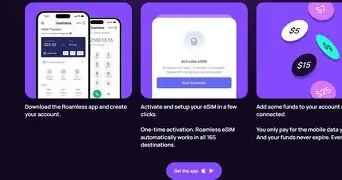
Provisioning the built-in eSIM through the Roamless app was straightforward. In my experience, the app guided me through selecting short-term data packs in-country and global bundles reasonably well. I was surprised by how painless a few of the activations were — no QR codes or fiddly carrier pages, just a few taps in the app and a short activation delay.
That said, the app has rough edges. I encountered a bug where occasionally the app would show the wrong data balance after a purchase; a force-close and reopening corrected it, but it’s an annoyance when you rely on accurate balances while traveling. Firmware updates arrived OTA and were painless, though one update briefly disabled mobile tethering (a bug that was fixed in the next patch). Roamless' customer support responded within 24–48 hours when I reported the issue, which I appreciated.
Build Quality and Portability
Physically, Roamless is compact and feels premium enough in the hand. The shell is matte, resists fingerprints, and the device fits easily into a jacket pocket or small camera bag. The small LED display (not a full touchscreen) gives enough status information: signal bars, battery percentage, connected device count — nice and useful while on the go. I noticed minor scuffs after rough handling, but nothing significant; it’s travel-ready but not indestructible.
Weight is in the “noticeable but acceptable” category: I could carry it all day in my daypack without complaint, but it’s heavier than tiny credit-card hotspots. If you expect to be ultralight, keep that in mind.
Privacy and Security
Roamless supports modern Wi‑Fi security standards (WPA3 compatible) and lets you set a custom SSID and password, which I used to separate work devices from guest devices during group travel. The device also supports a private VPN pass-through; I tested this with my personal VPN and it worked as expected. For me, having consolidated control at the hotspot level was convenient: I could force a password change or disconnect devices from the app without hunting down each phone or laptop.
One security annoyance: the default admin password is printed in the quick-start material and not randomized on every unit. I recommend changing it during first setup; I changed mine immediately and also enabled the device firewall options in the app.
Find top-rated Electronics products at great prices.
See Deals →Reliability and Long-Term Use
After nine months, Roamless has been reliable overall. I experienced two notable issues: the app balance bug mentioned earlier and one episode of overheating during an extended day of heavy 5G tethering under direct sunlight that caused the device to throttle speeds temporarily. The latter is a realistic thermal limitation — sustained high-throughput 5G connections generate heat — but it’s worth noting for long outdoor use on hot days.
The battery has held up well without significant capacity drop in my time of ownership. Roamless also received a couple of firmware updates that improved stability and improved app reporting, which shows the manufacturer is still supporting the device. That reassured me as a buyer.
Pros & Cons
- Pros:
- Excellent urban 5G performance for multiple devices — smooth video calls and streaming.
- Long battery life for light-to-moderate use and useful USB‑C PD passthrough.
- Convenient eSIM provisioning and straightforward international data purchases in-app.
- Solid build quality and compact, travel-friendly design.
- Modern security features including WPA3 and VPN passthrough.
- Cons:
- App glitches (incorrect balance reporting) and occasional firmware hiccups early on.
- Thermal throttling under extended high-load outdoor use; avoid direct sunlight for long streaming sessions.
- Performance falls back to local network limits in rural areas — no magic when coverage is poor.
- Battery indicator can be imprecise at times.
How Roamless Compares (Quick Table)
| Model | Max Devices | Typical Real-World Battery | Network | Standout Strength |
|---|---|---|---|---|
| Roamless | Up to 20 (best at <10) | 24–30 hrs light use; 6–8 hrs heavy use | 5G + global eSIM | Best balance of battery, app-based eSIM convenience, and Wi‑Fi 6 |
| Competitor A (Glocal-style) | 10–15 | 18–24 hrs light use | 4G/5G with third-party eSIMs | Great for short trips and pay-as-you-go plans |
| Competitor B (Carrier Hotspot) | Up to 30 | 10–20 hrs | Carrier-specific 5G | Sometimes better local network optimizations, but less flexible internationally |
Buying Guide: Is Roamless Right for You?
In my experience, Roamless is a good fit for travelers and remote workers who need a reliable, flexible hotspot without juggling local SIMs. Consider these questions before buying:
- Do you travel across multiple countries frequently? If yes, Roamless' eSIM interface and global data options are convenient. I appreciated not having to buy local SIMs for short trips.
- Will you be the only heavy user, or are you usually sharing with a group? Roamless handled small groups well. For larger parties (10+ heavy streamers) performance will degrade; consider a dedicated travel router with higher throughput for big groups.
- Do you need day-long heavy usage? If you plan long days of continuous high-throughput connections (multiple laptop video streams), battery life will be the limiting factor; bringing a small power bank or using passthrough charging is a practical mitigation I used often.
- Are you concerned about privacy? Roamless supports secure Wi‑Fi standards and VPN passthrough. I recommend changing the default admin credentials during setup and enabling WPA3 where available.
- How important is post-purchase support? Firmware updates and responsive customer service mattered to me. The manufacturer pushed useful fixes during my ownership, which made the experience smoother over time.
Practical Tips from My Use
- Place the device near a window or higher location to maximize 5G reception — I noticed a 2–3x speed difference in some locations when I moved it a meter.
- Carry a compact 45W USB‑C charger to use passthrough charging for both Roamless and your laptop; it saved me multiple times on long travel days.
- Change the admin password immediately and enable any firewall features in the companion app for extra security.
- Keep an eye on firmware updates — some early stability issues were solved via OTA patches.
Conclusion
After nine months of real-world travel and daily use, I can say the Roamless is still a relevant, practical device in 2026. In my experience it strikes a strong balance between portability, battery life, and international convenience thanks to built-in eSIM support and a generally solid app experience. It's not flawless: app bugs, occasional thermal throttling, and natural limitations in rural coverage mean you should have realistic expectations. But for frequent travelers, digital nomads, or anyone needing a reliable, flexible hotspot without dealing with physical SIMs, Roamless remains a compelling choice.
Personally, I kept using it not because it was perfect but because it solved a real problem for me: consistent, hassle-free connectivity across borders, with reasonable battery life and the convenience of passthrough charging. If that matches your needs, Roamless is still good in 2026; if you need extreme throughput for large groups or guaranteed rural coverage regardless of local networks, you may want to complement it with other solutions.